
What a 0.6 mm Nozzle Changes in Real Production Printing
Why AFK Model Forge uses a 0.6 mm nozzle on the Creality K2 Combo, what it improves, what it gives up, and what still has to be checked in the slicer.
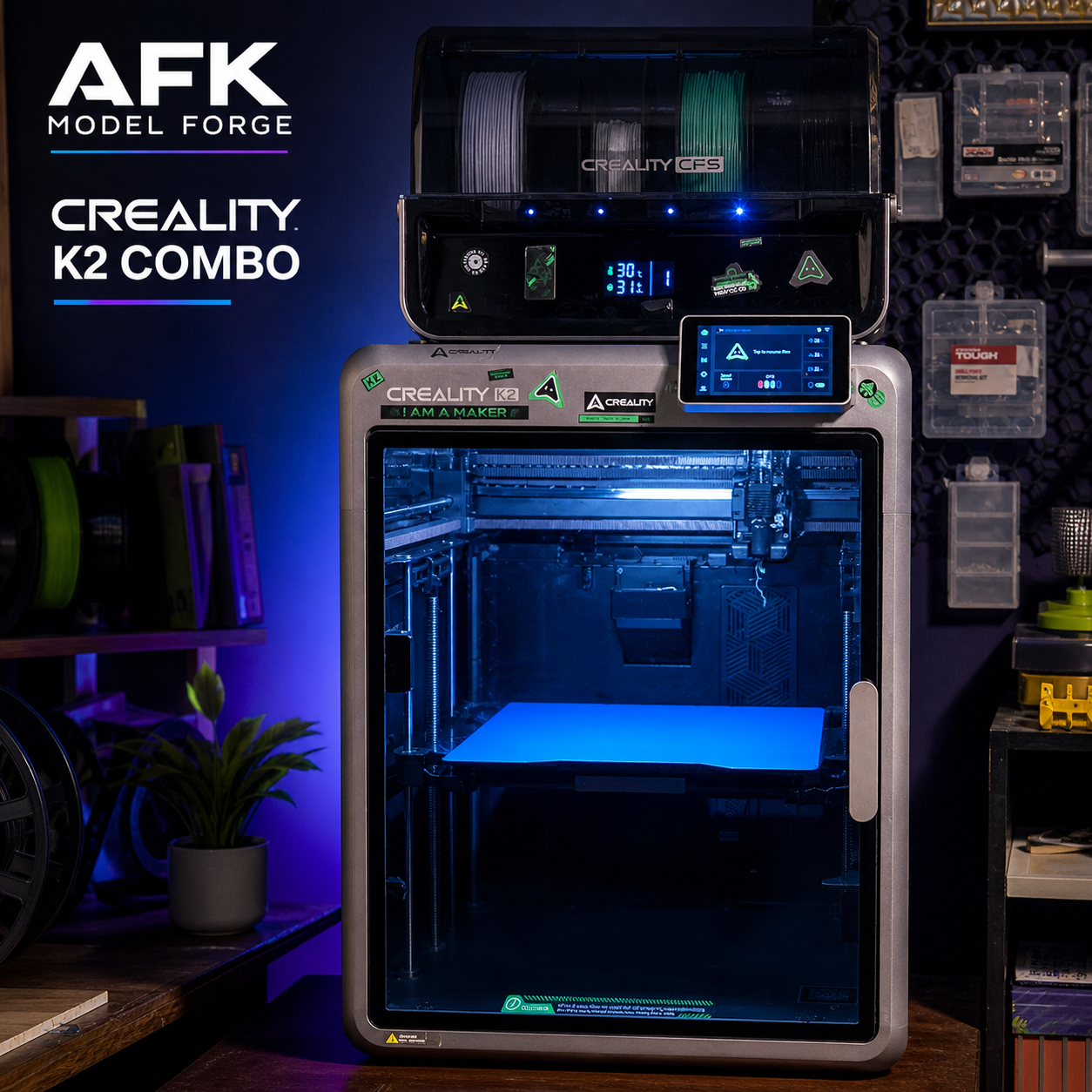
AFK Model Forge runs its current production workflow around a Creality K2 Combo with a 0.6 mm nozzle and a Supercool PEI build plate. That combination is useful for the kind of work we receive: functional pieces, branded shop tools, medium-to-large parts, multicolor accents, and customer files that need a practical balance between strength, detail, and turnaround time.
A 0.6 mm nozzle is not simply a 0.4 mm nozzle that prints everything faster. It changes the range of useful line widths, the smallest dependable features, the amount of plastic moved per second, support behavior, and the decisions we make before accepting a file.
Why we chose 0.6 mm
The wider nozzle can place wider roads of material. For suitable parts, that means fewer perimeter passes and fewer lines to fill the same cross-section. Larger functional models can complete sooner without relying only on extreme travel speed. Wider extrusions can also make walls more substantial with fewer perimeters.
That is valuable for drying bases, organizers, brackets, deck boxes, fixtures, and other products where the customer cares more about dependable structure and delivery time than microscopic surface detail. It is also a sensible match for a large-format printer: the machine can build sizable parts, and the nozzle helps keep those jobs from becoming unnecessarily long.
What “faster” actually depends on
The nozzle does not remove the hotend's flow limit. A slicer can request a wide, tall line at high speed that the melt system cannot supply consistently. The machine must melt enough material per second, the filament must feed cleanly, and cooling must keep up with the geometry.
For that reason, we check volumetric flow rather than assuming every 0.6 mm profile is a production profile. A larger nozzle often saves time through toolpath efficiency, even when the commanded speed is conservative. That is a more dependable benefit than chasing the highest number printed on a filament box.
Layer height and surface finish
A 0.6 mm nozzle supports a useful range of layer heights, but each choice has a visible consequence. Taller layers reduce layer count and suit practical parts. Shorter layers improve slopes and surface transitions but return some of the time savings.
The nozzle diameter does not make every surface coarse. Vertical walls can still be clean, and a good orientation can preserve important faces. The difference becomes more obvious on shallow curves, tiny text, narrow points, and miniature-scale details. When those features define the product, we evaluate whether the model needs redesign, a smaller nozzle, or a different production method.
Walls become a design question
Thin features that were drawn around a 0.4 mm workflow may slice differently at 0.6 mm. Modern slicers can vary line width and recover some geometry, but they cannot manufacture detail that has no printable cross-section.
We inspect embossed lettering, recessed logos, snap tabs, holes, channels, and decorative line art in the layer preview. A wall that exists in the CAD view but disappears in the slicer is not ready. Sometimes the correct fix is to thicken the feature. Sometimes it is to rotate the part so the feature is formed differently. Sometimes the customer needs the original design file rather than an STL so the geometry can be edited properly.
Strength is more than nozzle diameter
Wider lines can help create robust walls, but a 0.6 mm nozzle does not guarantee a stronger part. Layer adhesion, material condition, temperature, wall count, infill, geometry, and orientation still control how a part fails.
We look for force that tries to split layers apart. A clip printed upright may have attractive surfaces and weak layer direction. Turning it on the plate may improve the load path but require support cleanup. The nozzle is one part of that tradeoff, not a substitute for it.
Supports and clearances need another look
Support interfaces change when extrusion width and layer height change. A setting that separates beautifully in one profile can weld itself to the model in another. Wider lines can also close small gaps or change the finished size of narrow holes.
For assemblies, we avoid assuming that nominally matching dimensions will fit. We use intentional clearance and test critical interfaces when possible. Holes for hardware, sliding parts, press fits, and rotating joints deserve extra attention because the customer experiences the accumulated result of material shrinkage, line width, orientation, and machine calibration.
Multicolor waste can outweigh print-time savings
The K2 Combo can support multicolor work, but color changes introduce purge material and additional motion. A 0.6 mm nozzle may shorten the printing portion while a high number of color swaps still dominates the schedule and material use.
We inspect the color-change count and purge estimate before quoting. Strategic color placement, separate accent pieces, embossed layers, or a reduced palette can produce a cleaner and more affordable result than treating every colored region as a required tool change.
Our 0.6 mm preflight checklist
- Confirm the finished dimensions and the file's intended units.
- Slice with the actual K2 Combo, 0.6 mm nozzle, plate, and material profile.
- Inspect thin walls, lettering, holes, tabs, and clearances layer by layer.
- Check volumetric flow instead of trusting travel speed alone.
- Review supports for removal access and acceptable contact marks.
- Check strength relative to layer orientation and expected load.
- Review purge volume and color-change time on multicolor jobs.
- Confirm the complete order fits the single-build-plate service limit.
When a smaller nozzle is the honest answer
We do not force every model through the production setup. Miniatures, tiny text, very fine surface relief, and small mechanical features may deserve a 0.4 mm nozzle, an even smaller nozzle, or resin printing. AFK Model Forge's current service is designed around the capability and limits of the listed production configuration. If the file cannot meet the intended result on that equipment, the right outcome is to explain the limitation before taking payment.
The 0.6 mm nozzle earns its place by making a broad class of real customer work efficient and sturdy. Its value comes from matching the tool to the job, then verifying the sliced result rather than treating nozzle diameter as a shortcut.
Common questions
Will a 0.6 mm nozzle make every print faster?
No. It can reduce toolpath count, but the actual result depends on geometry, layer height, volumetric flow, cooling, material, and color changes.
Can a 0.6 mm nozzle still produce clean-looking parts?
Yes. Vertical walls and properly oriented features can be very clean. Very small lettering, shallow curves, and miniature details need closer review.
Does a larger nozzle guarantee a stronger print?
No. Wider lines can help, but material condition, temperature, wall design, layer adhesion, and orientation remain essential.